

Companies around the world commonly hire or contract security personnel to protect their employees, facilities, assets, and operations. In low-risk environments, security arrangements may simply consist of fencing, sign posting, and perhaps a night watchman. In higher-risk environments, companies may need a greater level of security, requiring them to engage private security contractors or even work directly with public security forces in the area (Ifc.org, 2020).
Companies have a responsibility to ensure proper hiring, training, rules of conduct, and supervision of private security personnel. They should also encourage public security personnel to use proper restraint when responding to situations related to the project (Ifc.org, 2020).

KEY PRINCIPLES
Good practice regarding the use of security forces is based on the concept that providing security and respecting human rights can and should be consistent. This translates into implementation of policies and practices that ensure security provision is carried out responsibly, with any response being proportional to the threat. Proactive communication, community engagement, and grievance redress are central to this approach, often through collaboration between security and community relations departments (Ifc.org, 2020).
Proactive communication, community engagement, and grievance redress are central to this approach, often through collaboration between security and community relations departments. Gender considerations are also important, as women often have different experiences and interactions with security personnel. These ideas are elaborated in five good practice principles presented in Figure 1 and discussed below.
Figure 1: Five Good Practice Principles.
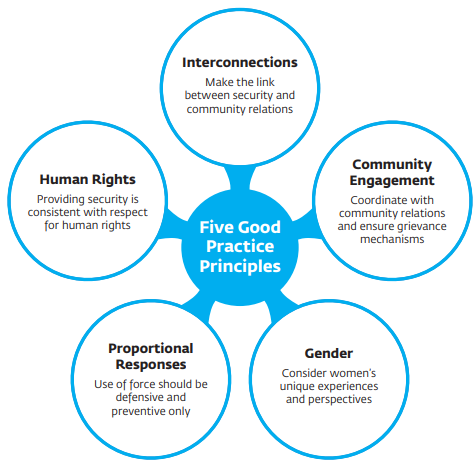
Source: Use of Security Forces: Assessing and Managing Risks and Impacts (Ifc.org, 2020).
The Principle of Proportionality responses.
In Security proportionality responses means that the intensity of any security response should correspond to the nature and gravity of the threat or offense. As per Performance Standard, companies should “not sanction any use of force except when used for preventive and defensive purposes in proportion to the nature and extent of the threat” (Ifc.org, 2020). Security personnel should be instructed to exercise restraint and caution, and to prioritize peaceful resolution of disputes and the prevention of injuries and fatalities.
Security and Human Rights.

Providing security and respecting human rights can and should be consistent. The connection between human rights and security is aligned with the commitment in Performance Standard that “Business should respect human rights, which means to avoid infringing on the human rights of others and address adverse human rights impacts business may cause or contribute to” (Ifc.org, 2020). Interactions with security forces have the potential to affect the rights and safety of individuals and communities. At the most extreme, the use of lethal force could result in loss of life. The use of excessive force, as well as unlawful detention, also may threaten the right to liberty and security of the person. Other possible impacts include limitations to freedom of movement or assembly or expression, or even restrictions on employees’ freedom of association (Ifc.org, 2020). Companies have a responsibility to ensure proper hiring, training, conduct, and supervision of private security personnel. They should also encourage public security personnel to use proper restraint when responding to situations related to the project.
Community Engagement and Grievance Mechanism for Security-Related Issues.
Making the link between security and community relations is key. Community engagement is a central aspect of a good security program, and good relations with employees and local communities can substantially contribute to overall security in the project area (Ifc.org, 2020). Companies can avoid internal operational silos by ensuring that their Security staff coordinate regularly with other departments, such as Community Relations and Human Resources. Through its Community Relations function, a company can share information with communities about security arrangements, the company’s security policies, and the expected conduct of security personnel (Ifc.org, 2020). Dialogue with communities about security issues can also help a company identify potential risks and local concerns, and can serve as an early warning system.
Gender Considerations.

Gender considerations are also important, as women often have different experiences and interactions with security personnel. For example, the potential for sexual harassment or sexual violence against women can increase from an expanded presence of private or public security forces in a project area (Ifc.org, 2020). Consulting women separately may offer important perspectives and may help companies identify a fuller range of potential risks and community concerns. At the same time, security personnel’s awareness of and respect for culturally specific gender issues may help the local population accept their presence (Ifc.org, 2020). Some companies have had success in improving cultural acceptance and reducing tensions by hiring female security guards, particularly in situations where there are frequent interactions between guards and women from the community.
Interconnectedness between Security and Other Performance Standards.
Experience has shown that company-community tension over any issue can quickly and easily become a security issue. Even small conflicts over any type of environmental or social concern whether water, lack of perceived benefits, pollution, or working conditions can suddenly turn into a spontaneous protest at the project gates or a blockade of an access road, resulting in a security situation that a company may not be prepared for (Ifc.org, 2020). Similarly, the proper actions of security personnel in the context of labour-union gatherings or strikes, involuntary resettlement of households, or activism by indigenous communities is essential in ensuring the rights and safety of local communities and to the reputation of companies and governments worldwide.
Did you find some great strategies in the post? What are the exciting ideas informing your security practice, and how are you implementing them? At Brinks Security We would love to hear from you, let us know in the comments.
If you enjoyed this post, I’d be very grateful if you would help it spread by emailing it to a friend or sharing it on Facebook and Twitter. Remember information is power and has the potential to change our community to be a safer place by adhering to the best practices of security.