

Crime within urban areas is complicated by the rapid urbanization, increase in urban population
and density which is associated with increased crime. Poor urban planning, design and
management have been increasingly cited as shaping the urban environment and putting citizens
and property at risk (Schneider & Kitchen 2002).
The physical fabric and layout of urban areas has a bearing on the movements of offenders, victims and opportunities for crime. It has been estimated that 10 to 15 per cent of crimes have environmental design and management component and effective urban planning, design and governance should seek to manipulate the built environment in ways that are intended to reduce or even eliminate the opportunity to commit crimes (UN Habitat 2007). Therefore, environmental design should solve problems that arise out of a variety of environmental conditions related to the building, the site, and the location and how the place is used.
The impact of crime and violence has significantly worsened in most cities over the recent years. These impacts include: Increased fear among urban residents; falling income resulting from the destruction or flight of businesses affected by the prevailing pandemic of Covid 19; growth of the private security industry and of urban gated communities; and the diversion of development resources towards investment in public and private security (UN- Habitat 2007).
Urban crime and violence in the world’s large cities are generally not a spontaneous occurrence,
but rather the product of inequality and social exclusion. Although rapid urbanization and
poverty partly explain the scale and extent of urban violence and crime, other factors such as the
political and economic climate, local traditions and values, and the degree of social cohesion and
solidarity among urban communities also play a role (Ellen M. Brennan, 1999).
Among the theorists of this group is Khan (1999), who attributes the growing urban crime to be a
series of socioeconomic factors, such as unemployment rates, underemployment, rapid
urbanization, low wages, social gap between the rich and the poor, educational levels, age
composition, and population growth rates. Key determinants in developing countries is
contributed by an explosive combination of modernization and fast urbanization, together with
high levels of social discrepancies, aggravated consumption levels, and political freedom, among
others (Khan 1999).
Covid 19 social economic insecurities.
Figure 1: Decline in labour-force participation rate in Kenya, 2019 and 2020
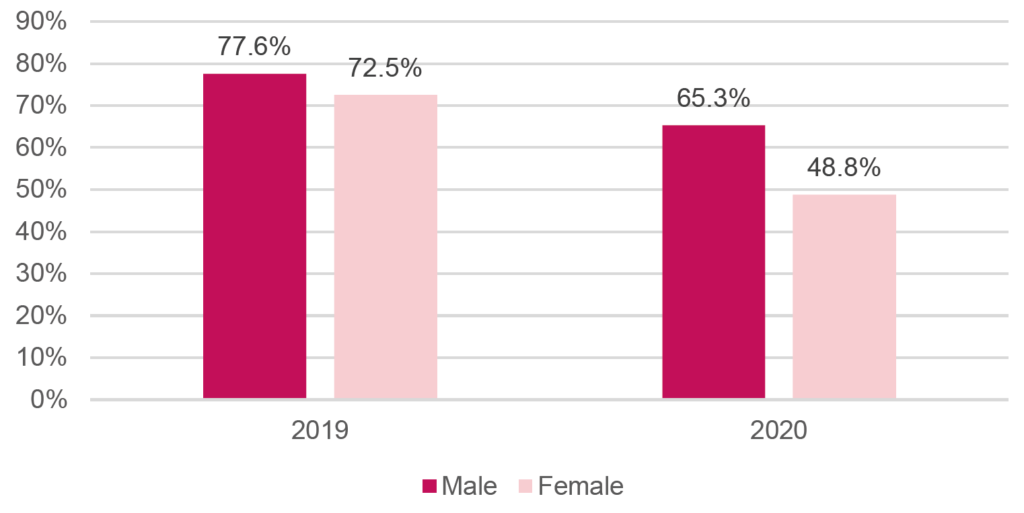
Source: Development Initiatives based on Kenya National Bureau of Statistics (KNBS) and the World Bank/ International Labour Organization model.
According to the KNBS survey, the virus has also disrupted the workflow as a result of curfews and requirements for people to stay at home. The average number of hours of work available per week for employees has significantly fallen in almost all sectors of the economy. The impact of this can especially be seen in the education sector and the hotel industry and has in turn contributed to reduced revenues and job losses (KNBS,2020).
Moreover, there is uncertainty about when most workers will be able to return to their jobs. About 91.2% of workers who reported absent from work during the period of the survey are not sure when they will return to work, while 8.9% expect their return to work to be delayed by between one and six months (KNBS, 2020). This has resulted to increased crime in Kenya as individuals have grown financial uncertainties which leads to frustration and anger and provokes criminal activities. Commercial enterprises revealed that they had been victims of burglary and theft as a result.
CCTV surveillance as a Situational Crime Prevention Mechanism.
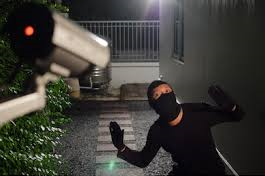
The central concept of situational crime prevention is that crime can be prevented by altering the
environment or the situation where offenses occur (Clarke and Homel 1997). Situational crime
prevention is based on a rational choice’s perspective, that individuals make choices based on
environmental cues (Clarke and Homel 1997). Situational crime prevention seeks to change how
potential offenders perceive opportunity in a particular environment or specific situation.
Technological advances have been incorporated as a crime prevention measure with the use of
CCTV being predominant. CCTV security system technology can be used in both internal and
external environments to enhance surveillance and protect people, property, vehicles and
valuables. CCTV equipment can provide instant alerts when problematic trouble occurs,
ensuring that crime against people, theft and vandalism are all substantially reduced and covered.
And when crime does occur, CCTV system incident recording can provide valuable evidence,
improving the likelihood of a conviction (Jerry’ Ratcliffe, 2006).
In solving this insecurity problem there is need to put several strategies in place that includes the
use of modem technology i.e. Closed-Circuit Television Camera (CCTV) cameras both inside the
buildings and on the streets. In addition, location and management of CCTV cameras are critical
in ensuring effective surveillance and response to crime incidents as practiced in Johannesburg,
South Africa. The use of CCTV Cameras enhances the current policing methods and has been
adopted by major urban cities in the world in controlling crime levels and improving urban
security and safety (Jerry’ Ratcliffe, 2006).
I urge all of us to play our part in ensuring that we obey government directives, stay safe and work from home. It is a tough time for us all and we can only achieve success in this fight if we work together. Let us all be our brother’s keeper.
As a company, we are committed to play our part in supporting the government’s efforts during this crucial time. We are also working to ensure that our customers continue to get uninterrupted security services and surveillance installation across the country.
We believe with the measures that we have taken through CCTV installations, Intruder alarm systems, Fire alarm systems, Fence systems and Electrical installations, we will win this fight together. As we always say, Brinks always there FOR ALL YOUR SECURITY NEEDS.
Have you been through some of this security challenges and haven’t felt motivated to do the things that you always loved doing?
What did you do to change?
Share with us today– we would love to hear from you at Brinks Family.